
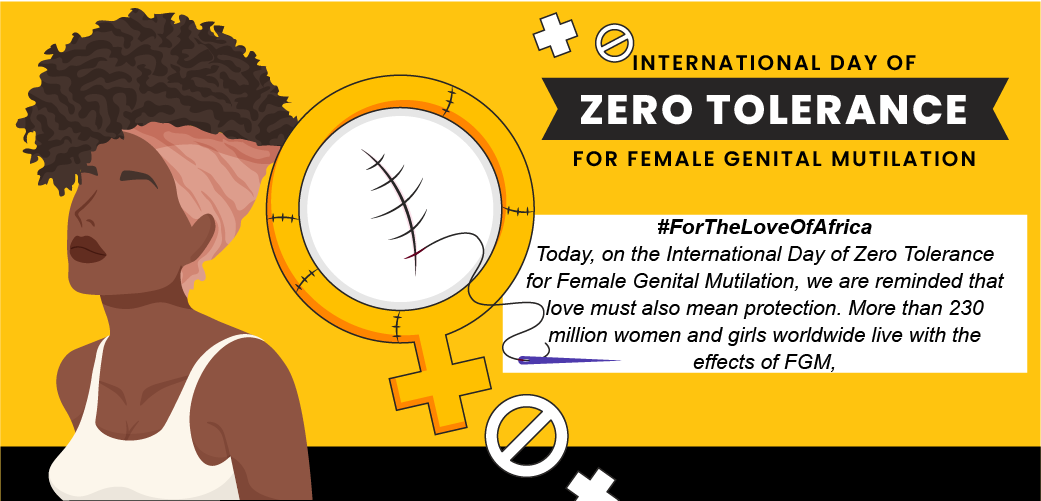
February often sparks conversations about love, shaped by ideas of romance and affection. Across Africa, however, love has long carried a deeper meaning. It shows up as protection, responsibility, and the refusal to allow harm to continue. This year, on 6th February, the International Day of Zero Tolerance for Female Genital Mutilation reminds us that love must also mean safeguarding the rights, bodies, and futures of girls.
Female genital mutilation (FGM) remains a serious human rights violation. More than 230 million women and girls across the world live with the scars of FGM- an alarming 15% increase since 2016. Despite global progress, the number continues to rise, underscoring the urgency of sustained action. This is why the world observes this day with zero tolerance, affirming that no form of violence against women and girls can be justified by culture, tradition, or circumstance.
As we move through 2026, closer to the commitments set out in the 2030 Agenda, ending harmful practices such as FGM remains central to achieving gender equality under Sustainable Development Goal 5. Protection of the girl child is not an abstract goal. It is a measure of how societies value dignity, health, and choice, and how seriously they take the promise of equality.
While global institutions continue to mark this day through coordinated action, much of the meaningful progress across Africa has been driven by communities and governments working from within.
In Senegal and across parts of West Africa, Tostan has supported community-led dialogues that empower villages to collectively abandon FGM and child marriage. By engaging elders, women, youth, and religious leaders, this approach centres shared values rather than external pressure, allowing communities to redefine social norms on their own terms.
In Kenya, government-supported efforts led by the Anti-FGM Board have strengthened legal enforcement while working closely with communities to promote Alternative Rites of Passage. These initiatives respect cultural transitions into adulthood without subjecting girls to harm, demonstrating that tradition and protection do not need to stand in opposition.
Sudan’s Saleema Initiative offers another powerful example of change rooted in positive identity. By reframing social norms and promoting the idea of girls being “Saleema,” meaning whole and unharmed, the campaign has contributed to shifts in public attitudes and supported national efforts to criminalise FGM.
Across Ethiopia and neighbouring regions, grassroots women’s networks and survivor-led organisations continue to play a critical role in prevention and care. Through education, peer support, and advocacy, these groups challenge deeply rooted practices while ensuring that survivors are supported with dignity and compassion. One such example is KMG, a community-led organisation in southern Ethiopia that has worked for decades with women, elders, and local leaders to end FGM through dialogue, cultural transformation, and survivor empowerment.
Together, these efforts reveal a shared truth. Ending FGM requires more than awareness. It demands sustained commitment, survivor-led solutions, and communities willing to protect girls not just today, but for generations to come.
As United Nations Secretary-General António Guterres has urged, “Let us join forces to make female genital mutilation history and ensure a brighter, healthier, and more just future for all women and girls everywhere.” This call speaks to love in its most powerful form. Love that protects. Love that resists harm. Love that chooses dignity and safety for every girl.
0 Comments