
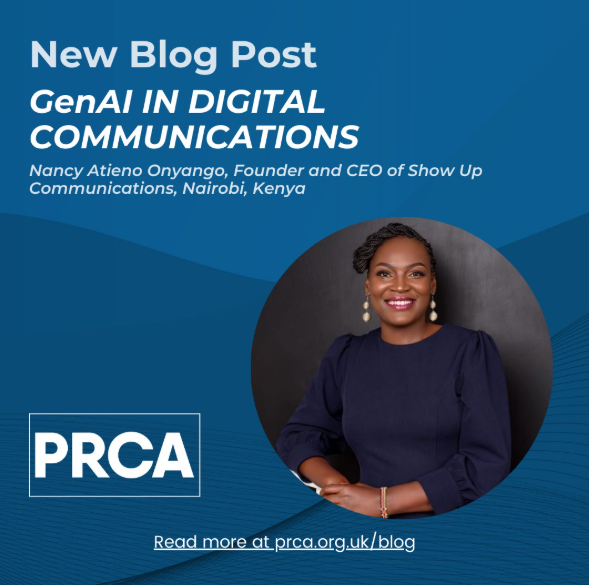
Generative artificial intelligence (GenAI) isn’t just a passing trend; it represents a significant shift in digital communications. In the latest blog by our founder and CEO, Nancy Atieno Onyango, published by The Public Relations and Communications Association (PRCA), she explores how GenAI is transforming digital communications and what this means for both global and African brands.
From Coca-Cola’s AI-powered Christmas campaign to Sephora’s personalised customer experiences, we witness how GenAI is reshaping content creation, campaign execution, and audience engagement. However, it’s not solely about efficiency. GenAI challenges traditional communication theories, raises ethical questions, and redefines the role of communication professionals. These roles now encompass content creation, strategic oversight, and ethical stewardship of AI-driven narratives. Communications teams dedicate significant time to drafting press releases, blog posts, social media captions, newsletters, and video scripts to bolster digital communication efforts. Those executing digital campaigns must tailor messages for various audiences, maintain a consistent brand tone, and stay relevant in real time, all while navigating rapid news cycles and engaging diverse audiences across platforms such as Facebook, LinkedIn, TikTok, Instagram, X/Twitter, and YouTube. They also need to respond promptly to comments and crises, localise content for different regions and languages, repurpose stories for various formats, and support internal and executive communications, all under tight deadlines amid a noisy digital landscape.
A McKinsey report from 2023 highlights that organisations leveraging GenAI in content workflows have experienced an increase in production speed of up to 60%. McKinsey defines generative artificial intelligence (AI) as algorithms, such as ChatGPT, Google Gemini, and Meta AI, that create new content, including audio, code, images, text, simulations, and videos. Their research indicates that generative AI applications could add nearly $5 trillion to the global economy, boosting the overall impact of artificial intelligence by 15% to 40%. In the technology, media, and telecommunications (TMT) sector, new GenAI use cases are projected to contribute between $380 billion and $690 billion, including $60 billion to $100 billion in telecommunications, $80 billion to $130 billion in media, and $240 billion to $460 billion in high tech. It may even be that within the next three years, anything not connected to AI will be deemed obsolete or ineffective.
According to The Future of Professions report, the AI adoption curve within professional organisations is shifting from the innovation phase to the early adoption phase, indicating a growing trend. This transition aligns with Everett Rogers’ Diffusion of Innovations theory (2003), which explains how new ideas and technologies spread across a social system through distinct adopter categories: innovators, early adopters, early majority, late majority, and laggards. As AI tools, such as generative AI and automation platforms, showcase practical benefits, more organisations are progressing from experimentation to broader implementation, led by influential early adopters who serve as opinion leaders and role models in their sectors. While brands and organisations in countries like the US, China, and Japan are at the forefront, African-based brands and companies are rapidly catching up. Arakpogun et al. (2021) argue that while African countries may lag in readiness, they also have the opportunity to leapfrog traditional communication methods and move directly to AI-enhanced practices.
However, a myriad of challenges hampers the development and adoption of AI technologies in Africa. These challenges include a lack of a structured data ecosystem, insufficient infrastructure, a digital divide, inadequate capacity building in AI, and limited avenues for acquiring innovation skills. By embracing GenAI, communications managers can ensure their brands remain competitive in the global race for audience attention, as demonstrated by leading global brands such as Coca-Cola, Heinz, Sephora, and Nike.
Read more https://www.prca.global/news/genai-digital-communications
0 Comments