
As the month of love comes to an end, it invites a deeper reflection on what love looks like beyond sentiment. Across Africa, love has long been expressed through service, solidarity, and collective responsibility. It appears in the everyday work of people and organisations who choose to stand with communities, respond to need, and pursue long-term change even when conditions are difficult. World NGO Day, 27th February, offers a moment to recognise this quieter, enduring form of love.
Long before the term “NGO” became common, African communities organised themselves to care for one another through mutual aid, faith-based initiatives, liberation movements, and local associations. Today’s non-governmental organisations are rooted in these traditions. They exist not only as formal institutions but also as expressions of a long-standing culture of collective action, in which communities step in to address gaps, defend rights, and imagine better futures.
Across the continent, NGOs play a critical role in development and social progress. They work across education, health, climate action, governance, humanitarian response, and peacebuilding, often operating closest to the people most affected by inequality and crisis. In education alone, their work is especially important in the Sub-Saharan region, where nearly 98 million children and youth remain out of school, the highest number globally. Vocational training and skills development initiatives, many implemented by civil society organisations, continue to equip young people with the knowledge needed to participate in growing economies. In the health sector, NGO-led community and mobile health initiatives play a vital role in expanding access, particularly in rural areas where Sub-Saharan Africa accounts for approximately 70 per cent of global maternal deaths, highlighting the importance of community-based health interventions. In many contexts, NGOs also support livelihoods and entrepreneurship, contributing to economic participation in Africa, where it is said that the region must create approximately 20 million jobs annually to meet the needs of its growing workforce. In these ways, NGOs continue to bridge the gap between policy and lived reality, translating national, continental, and global commitments into programmes that reach households, villages, and informal settlements.
This role matters deeply as Africa advances toward shared development goals. Agenda 2063 sets out a vision of an integrated, prosperous, and peaceful continent driven by its own citizens, while the Sustainable Development Goals provide a global framework for ending poverty, reducing inequality, and protecting the planet. NGOs help bring these visions to life. They support governments, complement public systems, and ensure that development efforts remain inclusive, accountable, and responsive to community needs.
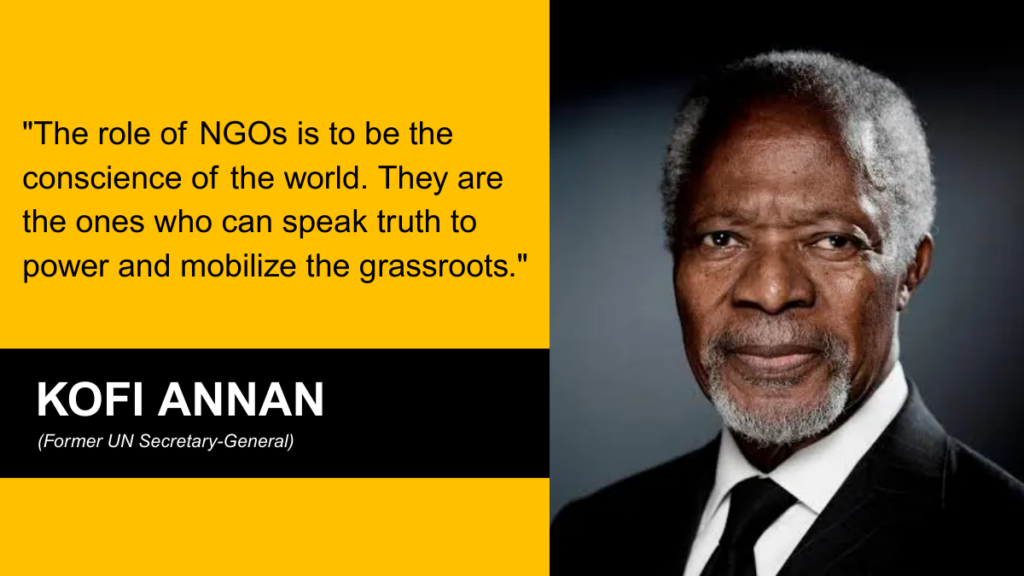
The importance of this work is underscored by the scale of global challenges NGOs respond to daily. From displacement and conflict to climate shocks and public health crises, civil society organisations are often among the first to act and the last to leave. Their flexibility allows them to adapt quickly, while their community trust enables solutions that are culturally grounded and locally led.
Across Africa, this commitment takes many forms. Some organisations focus on strengthening access to education and healthcare. Others defend civic space, support women and youth leadership, or protect natural resources. Many work across borders, recognising that today’s challenges do not stop at national boundaries. In doing so, NGOs reinforce the idea that Africa’s development is deeply connected to global cooperation and shared responsibility.
What unites this diverse work is purpose. NGOs are driven by service rather than profit, and by people rather than systems alone. Their impact is built through persistence, partnership, and care, often in environments where progress is slow and risks are high. In their daily work, NGOs turn love into action, translating care, solidarity, and responsibility into lasting change for communities.
World NGO Day is not only a moment of recognition but an invitation to reflect on the value of civil society in shaping a fairer future. It reminds us that progress is rarely achieved by governments or institutions alone. It is built through collaboration, trust, and the sustained efforts of people committed to others’ well-being.
In recognising NGOs, we acknowledge a powerful truth. Love, when lived through service and collective action, becomes a force for dignity, resilience, and transformation, and across Africa, this form of love continues to shape the future, one community at a time.
Follow us for more: LinkedIn
0 Comments