

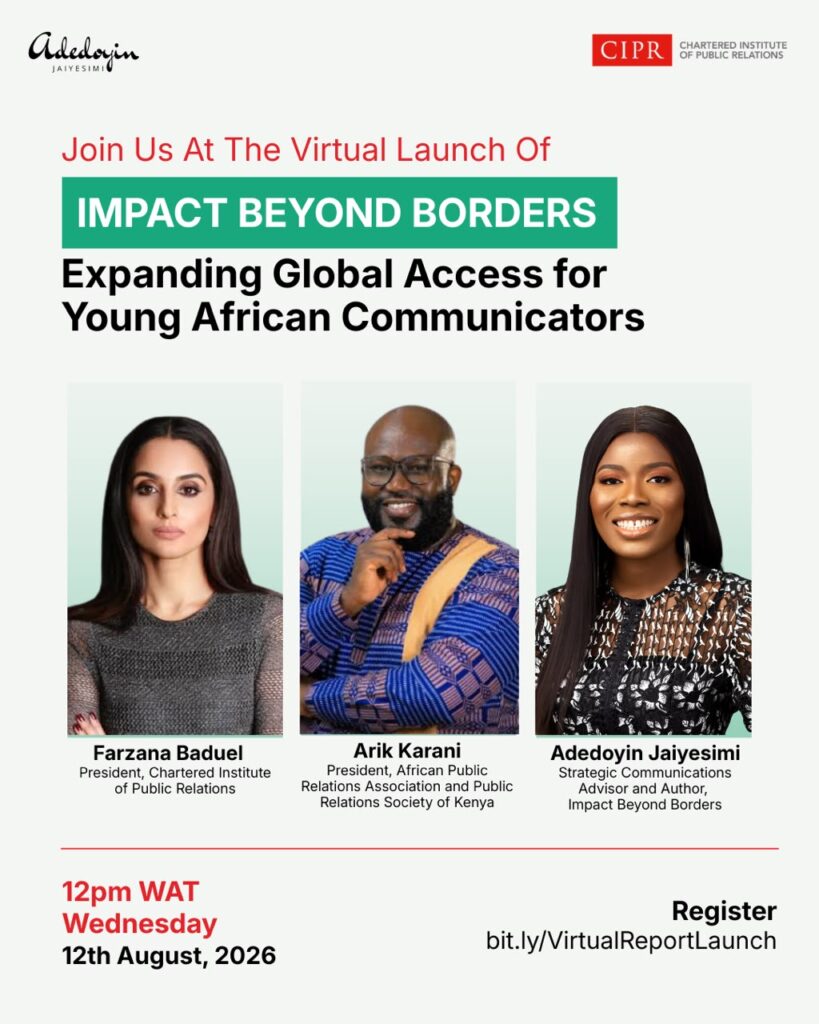
In a world where talent knows no borders, opportunity often does. Impact Beyond Borders aims to challenge this divide for young African communicators. How can we bridge that gap?
On 12th August, the virtual launch of Impact Beyond Borders: Expanding Global Access for Young African Communicators unfolded as more than a research presentation. It was a moment of reckoning for the communications profession, a reminder that while Africa is home to the world’s youngest population, its early-career professionals remain locked out of global opportunities.
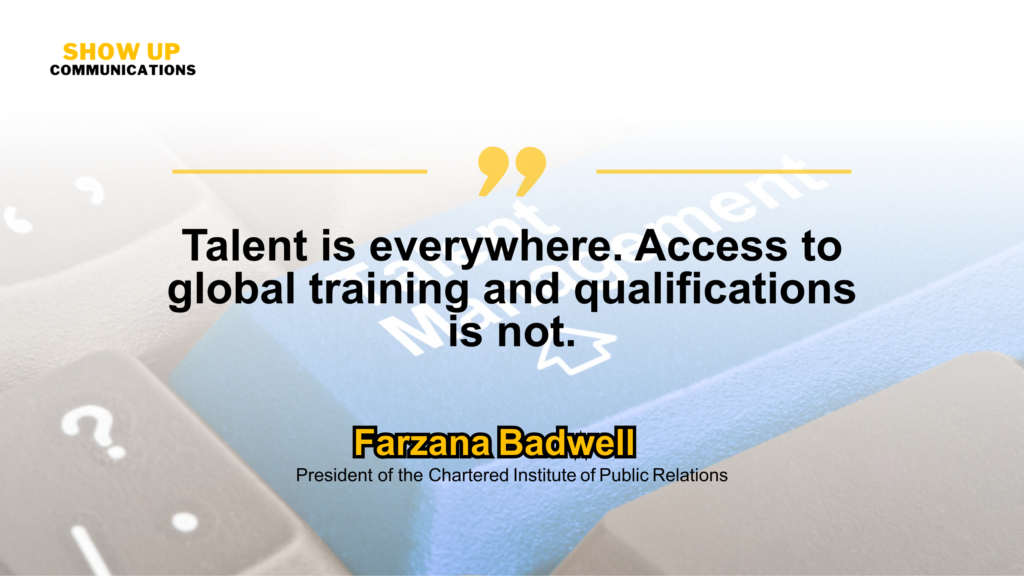
The discussion opened with a striking reminder that sub‑Saharan Africa is home to the world’s youngest population (70 per cent under 30) , yet its early‑career professionals face systemic barriers that limit their growth. These are not abstract challenges; they are lived realities. Many young communicators struggle to afford global certifications, lack awareness of training opportunities, or find that the content available does not reflect their world. Farzana Badwell, President of the Chartered Institute of Public Relations, captured this imbalance with clarity: “Talent is everywhere. Access to global training and qualifications is not.” She explained that CIPR has partnered with the Institute of Public Relations Zimbabwe to offer joint training and reduced chartership rates , which is a tangible step toward inclusion. Her call for a “consistent drumbeat of awareness” urged professionals to share opportunities widely, reminding everyone that awareness costs nothing but can change everything.
Tazima Kala, Chair of CIPR International, also reflected on how mentorship must move beyond polite encouragement to practical support. She recalled her first conversation with Adedoyin Jaiyesimi, when the research was still “in its baby stages,” and how that dialogue evolved into a global project. For Kala, mentorship is about opening doors through connecting young communicators to networks and knowledge that can transform their careers. She spoke of how a single person or opportunity can alter a trajectory, urging the profession to move from rhetoric to action. Her words carried weight because they were grounded in experience; she has seen how mentorship, when done right, becomes a catalyst for change.
Access also has a financial dimension, and Arik Karani, President of both the African Public Relations Association and the Public Relations Society of Kenya, offered a concrete example. In Kenya, PRSK has waived membership fees for students entirely, recognising that cost should never be a barrier to entry. “You can enter the way you are,” he said, describing how the organisation opens its doors without condition. This simple act of removing financial obstacles speaks volumes about what inclusion looks like in practice. Karani also highlighted APRA’s efforts to unite national associations across Africa, creating an ecosystem that connects young professionals from Nairobi to Lagos, Accra, and beyond. His message was clear: institutions must meet the ambition of young people with structural, lasting action.
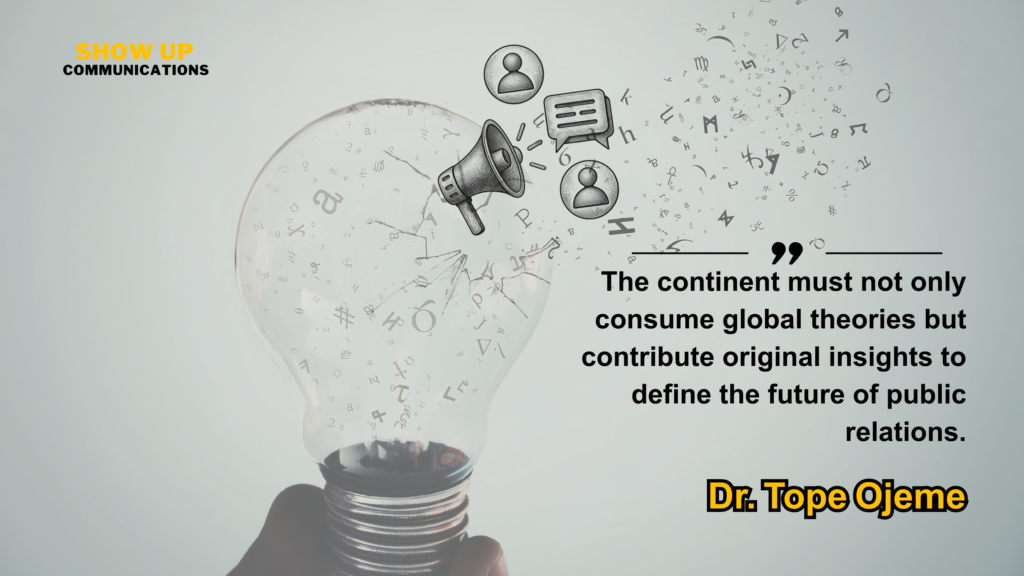
Dr. Tope Ojeme, representing the Nigerian Institute of Public Relations, added another aspect: the need for Africa to generate its own knowledge. He emphasised that the continent must not only consume global theories but contribute original insights to shape the future of public relations. He pointed to the upcoming World Public Relations Forum 2026 in Abuja, where over 126 countries will gather under the theme Responsible Communication: The Voice of the World. For him, initiatives like Impact Beyond Borders should feed directly into such global conversations, ensuring that African evidence and perspectives influence international practice. His advice to young professionals was simple yet profound: remain curious, embrace technology, but never abandon ethics because credibility is the profession’s greatest currency.
At the centre of the event was Adedoyin Jaiyesimi, whose research provided its purpose. She shared her experience of spending six years developing the Comms Avenue vision. During her encounters, she met countless young professionals seeking clarity on how to start their careers, grow, and define success in communications. The majority of them viewed global certifications as distant dreams. This became a motivation for her project, Impact Beyond Borders, which emerged from those conversations and was shaped by their frustrations. Impact Beyond Borders provides an evidence-based blueprint for dismantling barriers and expanding access, demonstrating that research can be both intellectually rigorous and deeply human.
As the event drew to a close, the ideas had merged into one continuous call: awareness must lead to mentorship, mentorship must demand structural access, and access must empower knowledge creation. The session ended with a sense of collective responsibility. As Farzana Badwell reminded everyone, “Talent is everywhere. Access isn’t, not yet.” The challenge now is to ensure that access becomes as universal as talent. The impact of this work is significant: it will open doors for a generation whose voices will shape the future of public relations, not only in Africa but globally.
0 Comments
Trackbacks/Pingbacks